

Unconventional Approach: Anti-Islamism Game Introduced
Germany's Federal Office for the Protection of the Constitution has launched a game designed to counter Islamism. It is targeted at children and teenagers aged 13 and above.
„Who is Bilal?” is the title of a game developed by the state of North Rhine-Westphalia in collaboration with the Federal Office for the Protection of the Constitution. According to a press release from the state government, the game’s aim is to „prevent Islamist radicalization and disinformation” and to „enhance media literacy, particularly among young people and young adults.” The development of the game reportedly cost €420,000.
The game focuses on a German man named Bilal, who becomes radicalized online. Players are tasked with observing his behavior and collecting clues that indicate signs of his radicalization. The game has sparked significant criticism among Muslims in Germany.
Under the leadership of Prime Minister Hendrik Wüst (CDU), North Rhine-Westphalia released the game in conjunction with the state’s Federal Office for the Protection of the Constitution to combat Islamist radicalization.
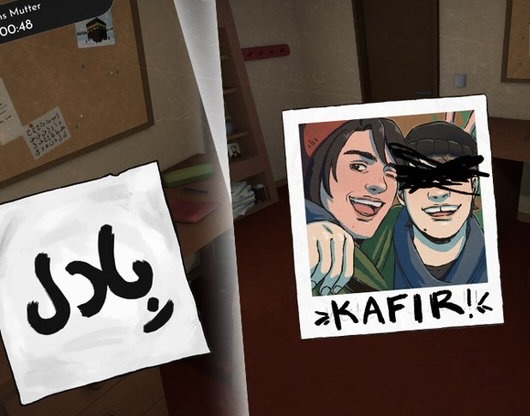
The game’s interface resembles a smartphone. At the start, players receive an SMS from the mother of a boy who has seemingly disappeared. The boy’s name is Finn.
Hendrik Wüst startet fabelhaftes Anti-Islamismus Spielhttps://t.co/VsP39FFLJx
— Ralf Schuler (@drumheadberlin) April 10, 2026
In the game, players can view Finn’s social media profile, where they must find clues indicating his change in perspective, as reported by Nius.
Finn transforms into Bilal and becomes radicalized
In the message, the mother reports that Finn has become increasingly withdrawn since their move and has recently been deeply engaged with Islam and his Bosnian heritage. He is reportedly exploring historical events such as the Srebrenica massacre and reading more of the Quran. He attempts to impose strict rules on his environment, leading to a situation where Finn tried to dictate how his mother should dress.
The game allows players to gather clues about his radicalization, such as in Finn’s room: a printed photograph of his friend Konstantin is labeled „kafir” (infidel), while another photo of an acquaintance is marked „mutabarrijat,” referring to women who do not cover themselves. Finn cuts ties with his old friends, isolates himself, and adopts the identity of Bilal—a transformation that players can track step by step.
On social media, one user described the game as promoting „Islam hatred,” and it has sparked outrage on Instagram following its release. Many users have accused the game’s creators of Islamophobia.
Interior Minister Herbert Reul commented on the new anti-Islamist game: „Radicalization does not happen suddenly; it occurs step by step. It often starts online, through chat programs, videos, and games, frequently unnoticed. This is precisely where we need to resist. With this new game, we are taking our preventive work to the next level. Young people will experience how extremists operate online and see how their narratives function. They will learn how to recognize manipulation in time and how to say no. By empowering young people with confidence, media literacy, and a clear set of values, we provide the best protection for our democracy.”