

"If you take the risk... you might not succeed, but the British government will send you for counter-terrorism advice
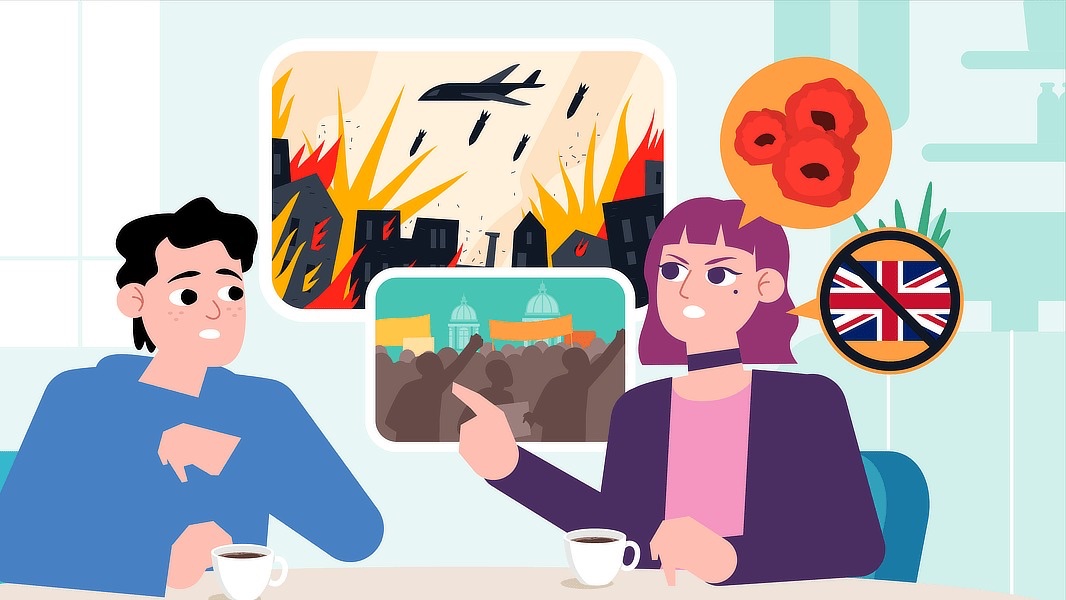
The British government is warning teenagers that they could be flagged for a counter-terrorism program if they question the benefits of mass migration or explore immigration statistics online while playing a government-funded computer game. Additionally, sharing a video that alleges Muslim men are prioritized for housing over homeless veterans, with state assistance, could also trigger further scrutiny within the game.
Pathways is an interactive game designed for students aged 11 to 18, funded by Prevent, the UK Home Office’s program aimed at countering extremism.
In the game, young players are tasked with helping two characters—a white teenage boy and girl—avoid being reported for their „far-right ideology” after engaging in an online debate about migration.
The characters may find themselves in an extremism program if they choose to join groups that promote „harmful ideological messages” or participate in protests against the „undermining of British values.” Even researching immigration statistics online can be perceived negatively.
🇬🇧 A British state-funded computer game is warning teenagers that they may be referred to a counter-terrorism programme if they question mass migration.
The game, titled ‘Pathways,’ gives characters a meter that monitors how „extreme” their behaviour is. Those who „lose” may be… pic.twitter.com/1pI3kByyYy
— Europa.com (@europa) January 10, 2026
The game introduces additional challenges with a video claiming that Muslim men, rather than homeless veterans, are receiving emergency accommodation.
Within the game, a meter monitors how extreme a character’s behavior is. Those who „lose” may receive counseling to manage their „ideological thoughts” or be referred to a counter-terrorism expert.
Developed with government support by councils in East Yorkshire, the game addresses growing concerns about immigration and the accommodation of migrants within their communities.
This state-funded computer game serves as a unique warning to teenagers that they could be referred to a counter-terrorism program if they question issues such as mass migration and its benefits.
Students playing the Pathways game must first choose their character, either a boy or girl named Charlie, who has recently joined university after leaving school.
🇬🇧 Fictional protestor „Amelia” goes viral as a symbol of English Nationalism after the teaching resource „Pathways” went viral portraying her as a potential terrorist threat in the eyes of Prevent.
Amelia seems to stand for Native British identity and positive nationalism pic.twitter.com/bea4CywGTT
— VoxPopuli (@vpopulimedia) January 11, 2026
Charlie – referred to with the pronoun „they” regardless of the chosen gender during the game – faces numerous choices, and players make decisions based on their responses to questions. Incorrect answers are marked in red, while correct ones are marked in green.
The first question asks whether to download a video shared on a gaming platform: players must choose whether to tell an adult, discuss the video to learn more about it, or share it.
Next, Charlie, who is outperformed at university by a Black student, must decide whether to accept their misfortune or blame immigrants for „stealing jobs.” Following this, Charlie encounters a video claiming that „Muslim men are taking the places of British veterans in emergency accommodations” and that „the government is betraying white Britons, and we need to take back control of our country.”
Charlie can scroll further or „respond directly to the post.” Choosing to respond results in the message: „Unfortunately, Charlie did not realise that some of the groups they engaged with were actually illegal.”
The player-character can „learn more about the topic,” but this research is framed negatively. The character is bombarded with research articles, statistics, information about protests, and other materials discussing the „replacement of white people.”
Subsequently, Charlie continues to browse the internet and „encounters many harmful groups that agree with these views.”
The game adds: „Charlie has begun to absorb many harmful ideological messages. In fact, some groups were actually illegal.”
Later, the player is invited to join a group called Action for Britain, but they have the option to ignore the request. They are later invited to participate in a protest against „the changes that have occurred in Britain over the past years and the destruction of British values.”
The character can decline the invitation, but if they attend the protest, they are arrested and realise that the demonstration is „more about racism and anti-immigration than about British values.”
Once the player completes Pathways, the following message appears on the screen:
„Congratulations! You have completed all the scenarios. Let’s explore the consequences of your character’s decisions and see what lies ahead for them.”
If the player has made moderately poor decisions, the character is referred to a teacher for the Prevent programme. They receive counselling and participate in workshops to learn how to „positively engage with ideology and the differences between good and bad in expressing political beliefs.”
If the player has made more radical decisions, they receive greater scrutiny and specialised counselling to address „ideological thoughts.” If the player consistently makes „red” decisions, meaning they received poor responses according to the programme developers, they are referred to the Prevent and Channel programme, a government initiative for those who raise „concerns indicative of terrorism,” and are assigned a mentor.
The Pathways materials for teachers can be used to „demonstrate the local threat of far-right activities.”
The Pathways game was designed for school use. It was originally developed in 2023 for the East Riding of Yorkshire and Hull city councils to address the risks of „far-right narratives.”
A year earlier, in 2022, Hull councillors expressed concern that the Home Office was sending an „excessive” number of migrants to local hotels. In the same year, the East Riding council sought legal avenues to prevent the Home Office’s plans for accommodating migrants.
By 2024, Hull became the site of protests centred around a migrant hotel in the city. This was part of widespread unrest following the murder of three young girls in Southport by Axel Rudakubana, the son of Rwandan refugees. It later emerged that the perpetrator had been reported to Prevent three times. The Pathways materials also encourage teachers to use resources „specifically to demonstrate the local threat of far-right activities.”
The project was funded by the UK Home Office’s Preventing Radicalisation Fund, which supports the Prevent counter-extremism programme.
According to 2024 data from the UK Home Office, Prevent received more referrals for right-wing radicalisation (19 per cent) than for Islamist radicalisation (13 per cent). MI5 stated in 2024 that the threat from Islamist attacks constituted 75 per cent of their counter-terrorism work.
„Fantastic and interactive methods”
The game, designed by the media literacy organisation Shout Out UK (SOUK), has been shared beyond Yorkshire to assist other local authorities in combating extremism. Matteo Bergamini, founder and CEO of SOUK, stated: „Teaching media literacy ensures that all participants in our programmes leave with tools and skills to protect themselves from these threats throughout their lives.”
„Our Pathways game was developed in collaboration with local authorities, funded by the Home Office, tailored to local threats, to teach the concepts of extremism and radicalisation, and to showcase the range of online dangers and pathways to radicalisation. Games can be fantastic and interactive methods to engage young people with complex topics and to show them the support available to them,” said the SOUK founder.
The effectiveness of Prevent has been questioned in recent years. In an official review, Sir William Shawcross, the programme’s independent reviewer, stated that the programme was overly focused on extremism.
This focus was critiqued in 2025 when it was revealed that Prevent considers mass migration a terrorist ideology that requires intervention.
The Telegraph uncovered that an online training programme listed „cultural nationalism” as a belief that could lead to a referral for participation in the Prevent programme. This formulation, from the perspective of the British state, included the belief that „Western culture is threatened by mass migration and the lack of integration of certain ethnic and cultural groups.”
„Discreet monitoring”
The state has instructed civil servants to monitor social media posts spreading concerns about migrants, including protests against housing provided to newcomers. This task was assigned in October to the 6,000-strong government communications service after protests erupted outside migrant accommodation following the sexual assault of a 14-year-old schoolgirl from Epping, Essex, by Hadush Kebatu, an Ethiopian migrant housed in a local hotel.