
Woke Madness steps to a new level in Brussels
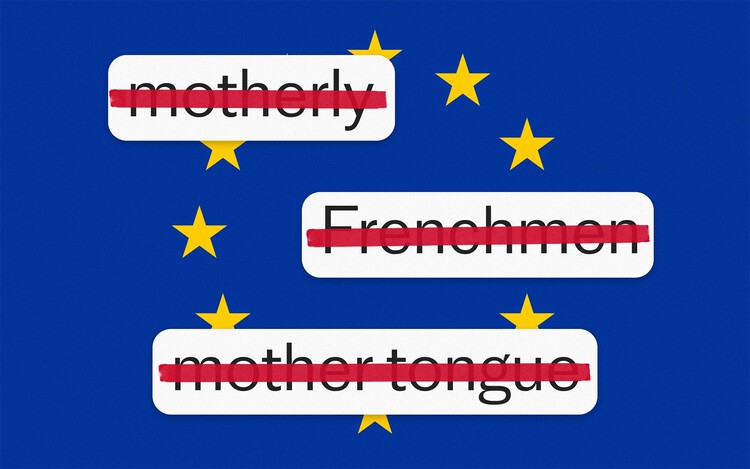
The terms "mother tongue," "maiden name," and "masterpiece" have now been added to the list of "forbidden" words in a guide aimed at promoting "gender equality" through unique solutions for European linguistic integration. This guide encourages individuals to refrain from using the terms "woman" and "man" to distinguish between genders, as such distinctions are rooted in medical and biological contexts.
The guide has once again sparked outrage, proposing a ban on certain words that have been part of everyday life for centuries. These terms not only feature in common speech but also reflect the evolution of language itself. Some expressions carry emotional weight, such as the adjective „maternal,” which is used in phrases like „maternal instinct,” „maternal love,” and „maternal feelings.”
Funded by the European Union and published by UN Women, the guide seeks to eliminate these terms altogether. According to the EU-funded organization’s publication, the 38-page guide places the word „maternal” on its list of prohibited adjectives, suggesting alternatives like „loving” or „caring.”
Instead of „mother tongue,” the guide recommends using „birth language,” while „maiden name” should be replaced with „birth name,” and „masterpiece” should be referred to as „brilliant work.”
The new guidelines also advise schoolchildren to use „biological parent” instead of „mother,” as „not everyone who gives birth is a woman.”
The aim of employing gender-neutral language, according to the recommendations, is to counteract language that is „biased, discriminatory, or degrading,” as it implies that „one gender or social gender is the norm.”
EU bans ‘biased’ words like ‘Englishmen’ and ‘lady’ in major woke drive
https://t.co/2Fzpm2Yx5t— GB News (@GBNEWS) January 14, 2026
Instead, it contains detailed lists of terms deemed „non-sexist, inclusive, and gender-fair.” The document titled „Language Use Guide for Promoting Equality and Inclusivity” states: „Gender-fair and inclusive language helps reduce gender stereotypes, promotes social change, and contributes to achieving gender equality. The use of gender stereotypes, everyday inequalities, and seemingly trivial sexism contribute to a social atmosphere where women are demeaned, rendered invisible, have their self-esteem diminished, and their activities and choices limited, including in the workplace, private, public, and online spheres. The internet has added a new dimension to the expression and dissemination of sexism.”
The guide also advises against using the terms „woman” and „man” to distinguish genders, as this differentiation is typically employed in medicine and biology. „It is also recommended not to use titles that refer to a woman’s marital status, such as ‘Mrs’ or ‘Miss’, on the grounds that men’s marital status is never indicated. Use ‘Mr’ for men and ‘Ms’ for women,” the handbook states.
Examples include replacing „chairman” with „chair,” „policeman” with „police officer,” and „steward/stewardess” with „flight attendant.” The guide suggests using „they” instead of „he” or „she” when referring to individuals. It notes that in „natural gender languages” like English, there is a „general trend” to minimize the use of gender-referential terms as much as possible.
„If the individual specifically prefers the title ‘Mrs’ or ‘Miss’, then that can be used. If a title seems necessary, then ‘Ms’ is recommended, as it is more egalitarian and can refer to any woman, regardless of marital status.”
Not only words have come under fire—the guide warns that images can also „perpetuate gender inequalities.” It states: „In addition to striving for equal representation of women and men when selecting images, it is important to pay attention to the subconscious messages related to gender norms. For example, it is advisable to choose images where posture, facial expressions, gestures, and attire convey equal status and authority.”
„The terms ‘woman’ and ‘man’ define human beings, and these are the correct methods for denoting personality,” claims the guide compiled by UN Women. „The use of the terms ‘woman’ and ‘man’ to describe women and men reduces them to their reproductive capacities and reinforces the notion that the differences and inequalities between women and men are biologically based rather than social constructs. Use the terms ‘woman’ and ‘man’, ‘girl’ and ‘boy’, even when an adjective is needed.”
It cites examples such as „parliamentary men” instead of „male parliamentary representatives” and „female entrepreneurs” instead of „women-owned businesses.”
Linguists, politicians, and ordinary citizens have also protested. The guidance has sparked fierce backlash. Etymologists have warned that this approach would eradicate the historical richness of words like „masterpiece,” which originates from the requirement for aspiring craftsmen to pass an examination of their work to become „masters.”
Chris Philp, the UK’s shadow home secretary, stated: „We’ve all had enough of this politically correct nonsense. While Russia threatens Europe’s borders, a cost-of-living crisis looms, a flood of illegal immigrants pours into Europe, and the regime in Iran faces collapse, the last thing we should be worrying about is the banning of these long-used terms.” He added: „We must preserve our language and culture and not allow anonymous bureaucrats to interfere. This is yet another reason why returning to the EU is a bad idea.”
The UN Women’s agency is a conduit for leftist ideologies
The organization established to protect women has not been shy about promoting leftist ideologies in its campaigns, publications, and statements. In recent years, the neutrality of UN Women has been called into question, with some experts suggesting that the protection of women’s rights is being used to further their own objectives and promote their ideologies.
What is #CEDAWGR41 – and why does it matter? ⚖️
This new General Recommendation tackles gender stereotypes that limit women’s and girls’ rights in every area of life.
Swipe through 5 key takeaways from our Regional Consultation in Istanbul last week. (1/2 🧵) pic.twitter.com/8CXfXWKH1q
— UN Women Europe & Central Asia (@unwomeneca) December 12, 2025