

“Ministry of Truth”: fierce row erupts over Burnham’s new counter-disinformation centre
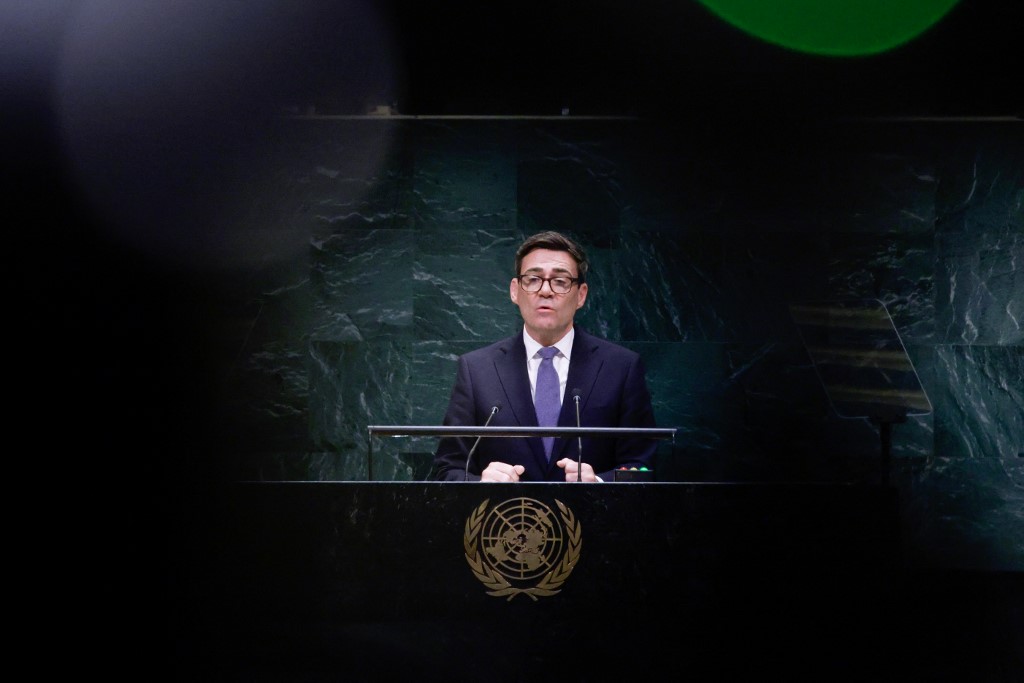
At the UN General Assembly, British Prime Minister Andy Burnham announced the creation of a National Centre for Information Defence. Its purpose is to detect and “disrupt” disinformation campaigns by hostile states. The government presents the move as a defence against Russian interference. Critics say it is yet another state tool that lets those in power decide which narratives count as “true” and which as “false”.
Burnham, who replaced Keir Starmer in July, gave his first UN General Assembly speech as prime minister in New York on Tuesday, 22 September. Its main announcement was the new centre. In the prime minister’s words, its job will be to “detect, attribute and disrupt” information operations by hostile states. Burnham spoke of a “poisonous tide” of disinformation and accused Russia of an “industrial-scale assault” on the information environment.
This is why I’m in New York. https://t.co/jkTjI5MPNK
— Andy Burnham (@andyburnham) September 22, 2026
According to the prime minister, Russian agencies use bots, fake websites and falsified newspaper articles, and have copied the branding of 28 British institutions, including universities and the BBC. Burnham claimed the Kremlin spends around £1.3 billion a year on manipulating information. He also accused Moscow of amplifying far-right narratives and trying to interfere in the 2019 UK general election. These are the prime minister’s claims; the reports do not mention any independent verification.
According to specialist media, the details remain vague. The Record understands that the Cabinet Office is leading the initial work. The centre would work with the intelligence agencies, government departments, the police and social media companies. There is no information on its budget or on what powers it will have. Downing Street said only that more details would be released later.
By the next day, a sharp political row had broken out. Nigel Farage, leader of Reform UK, said Burnham “is setting up a Ministry of Truth to clamp down on free speech,” and called it authoritarian government. The reference is to George Orwell’s novel Nineteen Eighty-Four, in which a state ministry rewrites reality.
Civil liberties group Big Brother Watch was more cautious but raised similar concerns. Its director, Silkie Carlo, acknowledged that acting against foreign campaigns is legitimate, but added: “we have already seen the mantle of countering ‘disinformation’ being abused by our Government.” The group wants strict limits on the new centre’s remit.
Bad memories of earlier units
The critics’ suspicion comes from past experience. In 2019 the British government set up the Counter Disinformation Unit, which was also originally aimed at foreign interference. According to a 2023 Big Brother Watch report, however, during the pandemic the unit also collected material on domestic critics. These included Conservative MP David Davis, who had criticised the lockdowns, and human rights campaigner Peter Tatchell, who had criticised the monarchy. The government had earlier said the unit did not “monitor political debate.”
Asked by GB News, the government stressed that the new centre is not being set up to monitor domestic dissent. That did not reassure the critics. GB News presenter Alex Armstrong asked whether the unit could be “weaponised to target British citizens who simply disagree with your Government.”
An agency, or an unaccountable office?
Security experts also see open questions. Sophie Williams-Dunning, a researcher at the RUSI think tank, said Britain “has been overdue a more coherent strategic response to this threat.” But she noted a big difference between a centre run inside the Cabinet Office and an agency accountable to Parliament. She also pointed out that the word “disrupt” suggests active, offensive action. France’s equivalent body, Viginum, only detects, attributes and debunks, and has no mandate for active intervention.
Joe Devanny of King’s College London said the new centre could be a simple relabelling of existing work, or a complete rethink of the whole system. For now it is unclear which.
A European trend
The British debate is not an isolated case. In the European Union, ever since the Digital Services Act (DSA), there has been ongoing debate over where the line lies between fighting disinformation and restricting unwanted opinions. Promoting “trusted” sources and “disrupting” hostile narratives are presented as security matters. Critics say it is increasingly the state that decides what may be said in public.