


Energy crisis: every fourth family business mulls job cuts
In Germany, soaring energy prices are forcing a significant number of family-owned businesses that struggle with high costs to cut jobs, while others are planning to relocate their production abroad.
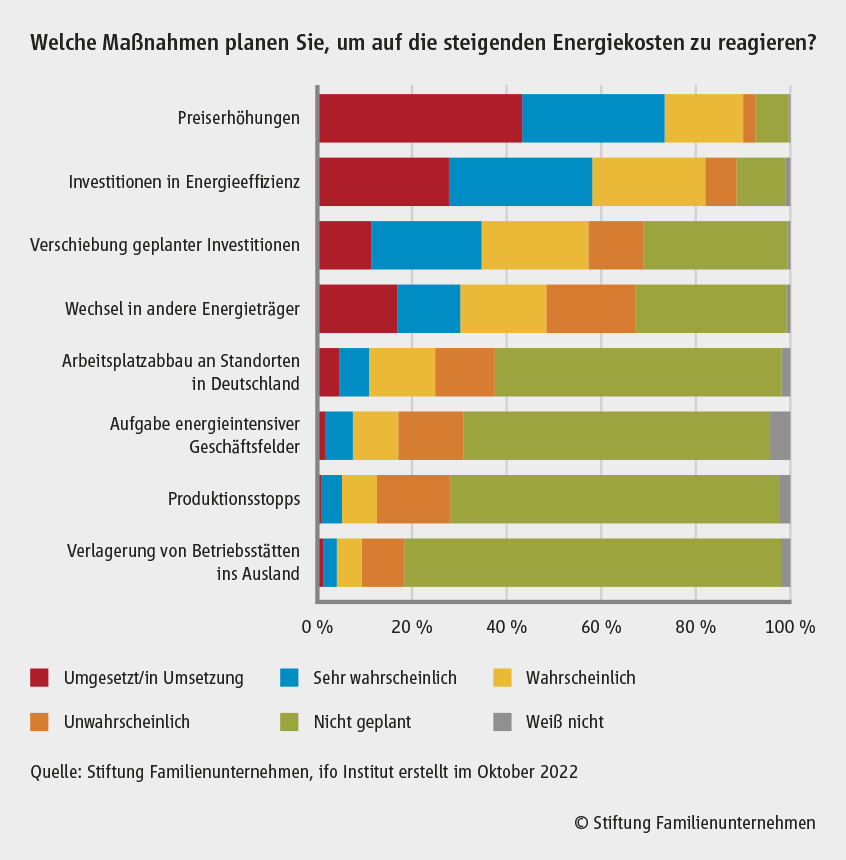
The drastic spike in energy costs has delivered a heavy blow to family-run businesses in Germany. The sky-high energy prices are forcing a growing number of businesses to postpone their planned projects. Even worse, they must discontinue production or move it abroad in certain cases. Many businesses also project that they will have to cut staff. These are some of the findings revealed in a recent survey by the Ifo Institute for Economic Research.
The study highlights that 90 per cent of the companies are likely to increase prices or have already done so. 25 per cent of the firms asked see laying off employees as a temporary solution, that is, every fourth company can only stay afloat if they cut some jobs. In a similar survey in April, only 14 per cent of the respondents were mulling staff reduction.
13 per cent of the respondents are planning to either partially or completely halt production for a while, whereas in April only 6 per cent saw this as a solution. Those opting for no stoppage are now mulling the option of of relocating their production abroad, where they can produce the same quality at lower costs. 9 per cent of the companies asked in the survey are considering such a move, while this figure stood at 6 per cent in April.
www.familienunternehmen.de
The energy crisis has dramatic consequences in other sectors as well. Every tenth construction company (11.6 per cent) reported in August that contractors had cancelled their orders in a large number of cases. Ifo highlighted several underlying reasons: a steep rise in construction costs, soaring material and energy prices, higher interest rates and lower subsidies have all contributed to the current plight of the construction industry, with some indications of this already showing in July, experts said.
More than a third (36,4 per cent) of construction companies surveyed still complained of serious material shortages in August. Ifo believes that many construction firms are planning further price increases.
Matthias Frederichs, general manager of the German Federal Association of Building Materials (BBS) warned that Chancellor Olaf Scholz must use all available energy sources amidst the looming gas shortage, or else Germany will be hit by a series of bankruptcies and a wave of emigration.
The construction industry is not the only sector impacted by a huge supply shortage. German retailers are also very concerned about replenishing their stocks. In August, 77.5 percent complained about supply problems, compared to 77.3 percent in July. There is currently no sign that the problems will ease in the period before Christmas, analysts say.
Meanwhile, almost two-thirds of the companies in East Brandenburg demand the easing of economic sanctions against Russia, saying that they have harmed German citizens and companies much more than the Russian government. in Moscow. A recent study by the East Brandenburg Chamber of Industry and Commerce (IHK) reveals that
the increased procurement costs and energy prices, along with the faltering and already broken supply chains have put more than half of the companies in a serious and uncertain situation. The most heavily affected sectors are logistics and the hospitality industry, with the overwhelming majority of companies in these sectors believing that Western sanctions are ineffective, because they have failed to end the war and bring Russia to its knees economically. According to the study, only eleven per cent of the companies surveyed believe that the sanctions are working.
In addition, with regard to the crude oil refinery near Schwedt, more than two-thirds of the companies argued in favour of the maintenance of crude oil deliveries from Russia.
Tags: